Previous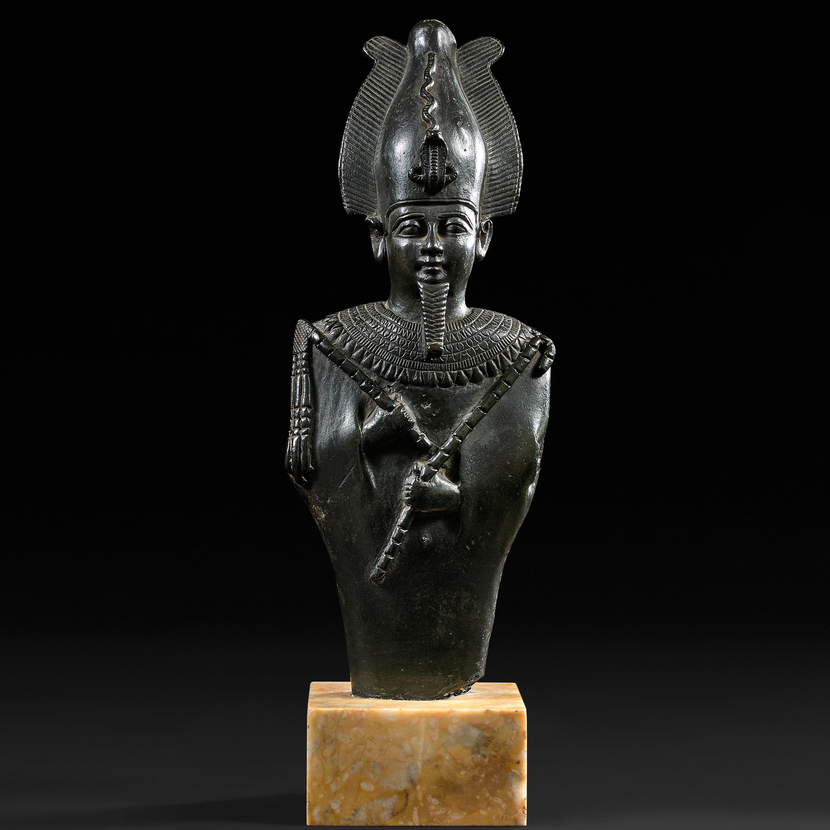
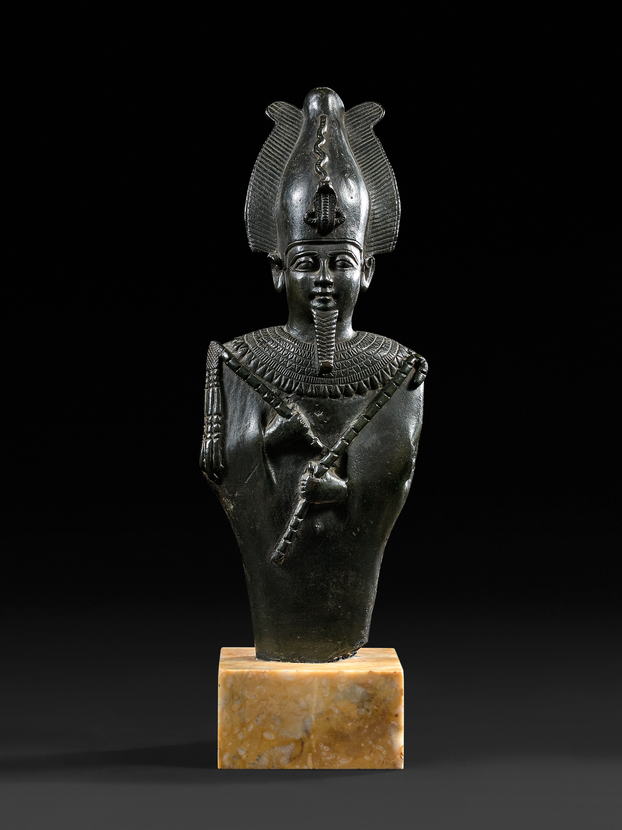
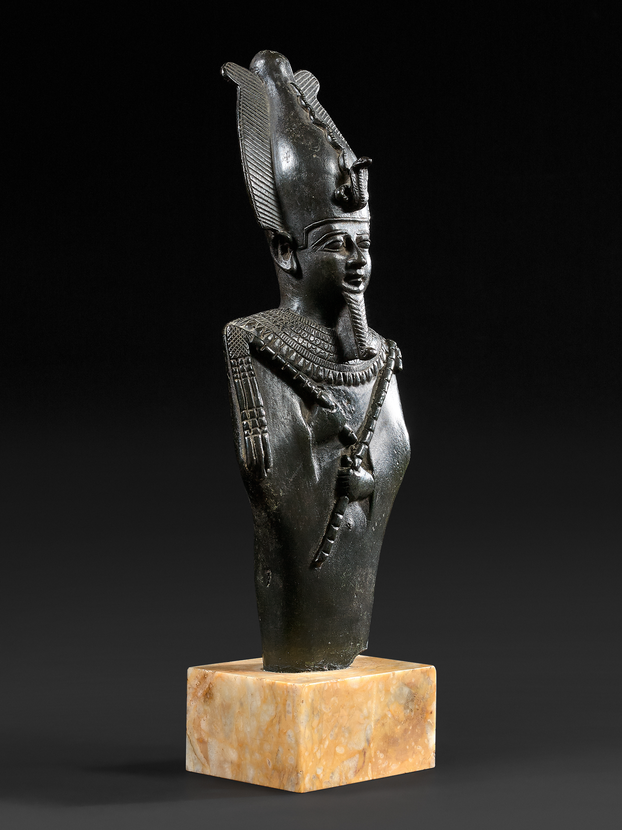
Statue of Osiris, Bust
The god is depicted wrapped in a tight-fitting fabric with hands protruding placed on his chest right above the left. Osiris is holding the crook and frail across his chest characterising him as the ruler of the dead, master of eternity. On his head, the Atef-crown, is another fixed element of the iconography of Osiris.
Egypt
Late Dynastic Period , 664-332 BC
Bronze
Height 24.1 cm ( 9 1⁄2 in )
Former private collection J.G.H. North Carolina, USA, acquired early 1960’s at Mattias Komor, New York, by descent from the above
G. Hart: Ein Wörterbuch der ägyptischen Götter und Göttinnen, Routledge & Kegan Paul, London 1986
E. Feucht: Vom Nil zum Neckar, Heidelberg, 1986
G. Roeder: Ägyptische Bronzefiguren, Staatliche Museen zu Berlin, Berlin 1956
S. Schoske & D. Wildung: Gott und Götter im Alten Ägypten, Phillip von Zabern, Mainz 1992
 Share
Share  Print
Print  Call Us
  Enquire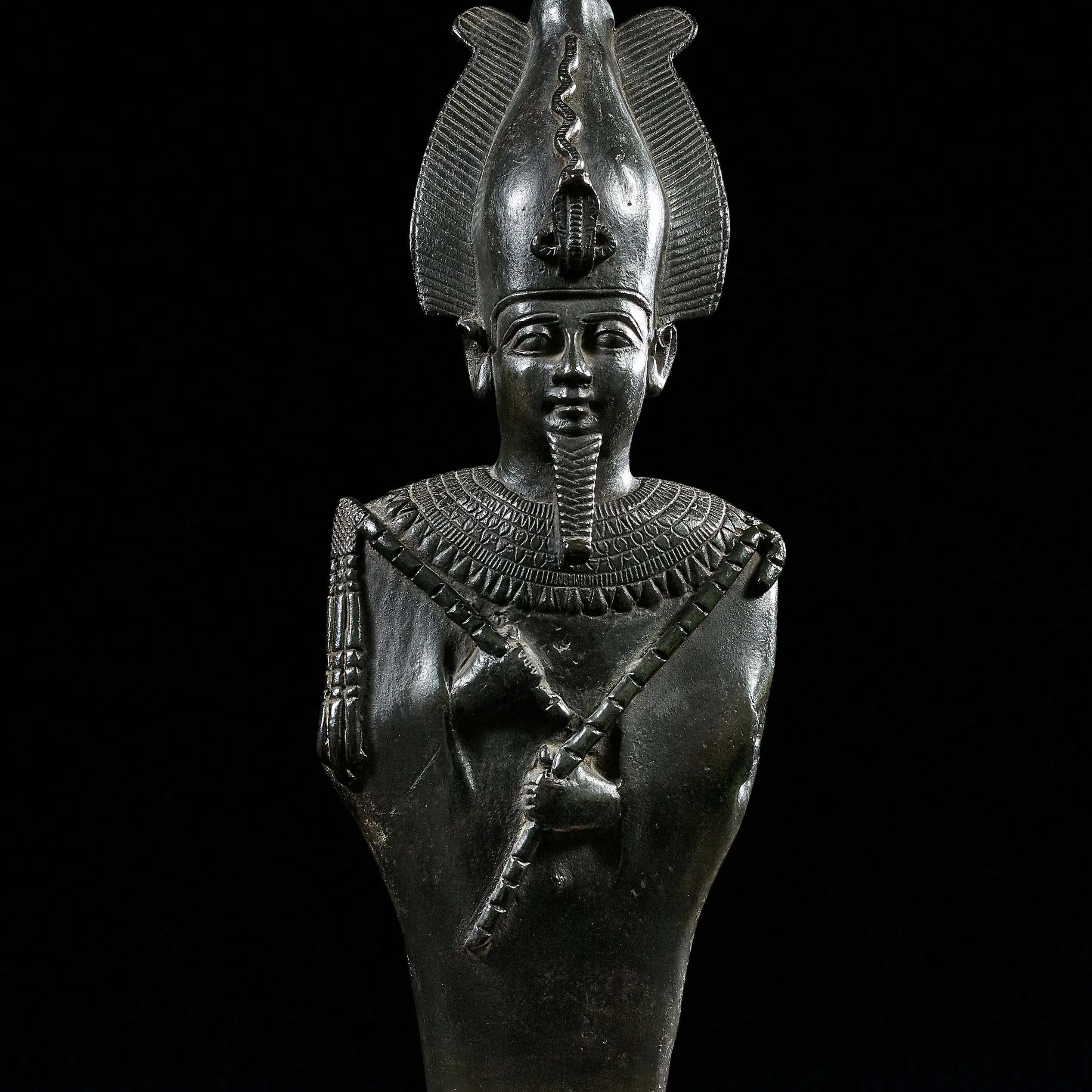
The god is depicted wrapped in a tight-fitting fabric with hands protruding placed on his chest right above the left. Osiris is holding the crook and frail across his chest characterising him as the ruler of the dead, master of eternity. A multi-stranded broad collar hangs across his chest and presents incised registers of repeating beaded, fretted, and teardrop-form motifs. On his head, the Atef-crown, is another fixed element of the iconography of Osiris. This consists of the tall White-crown of Upper Egypt flanked by two feathers with a frontal meandering cobra uraeus. Osiris wears the typical plated and curled divine beard on his chin.
Osiris was a complex deity who possessed an essentially dual role in the religion of ancient Egypt. Originally worshipped as a god of fertility, the god gradually accrued the trappings of a mummified god-king, ruler of the Underworld and lord of resurrection by assimilation with various local gods. In time the king, who in life was the embodiment of Horus, became Osiris in death — a transformation later extended to all Egyptians, bestowing for the first time the opportunity for an independent existence in the Next World. This development ensured Osiris a timeless and unbounded popularity that is reflected in the numerous votive images of the god in a variety of stones and metals.