Previous
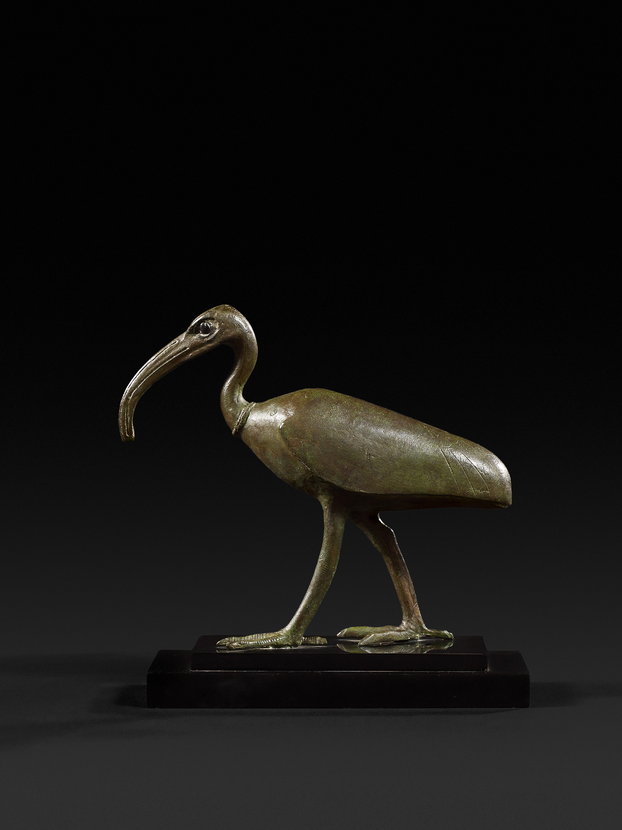
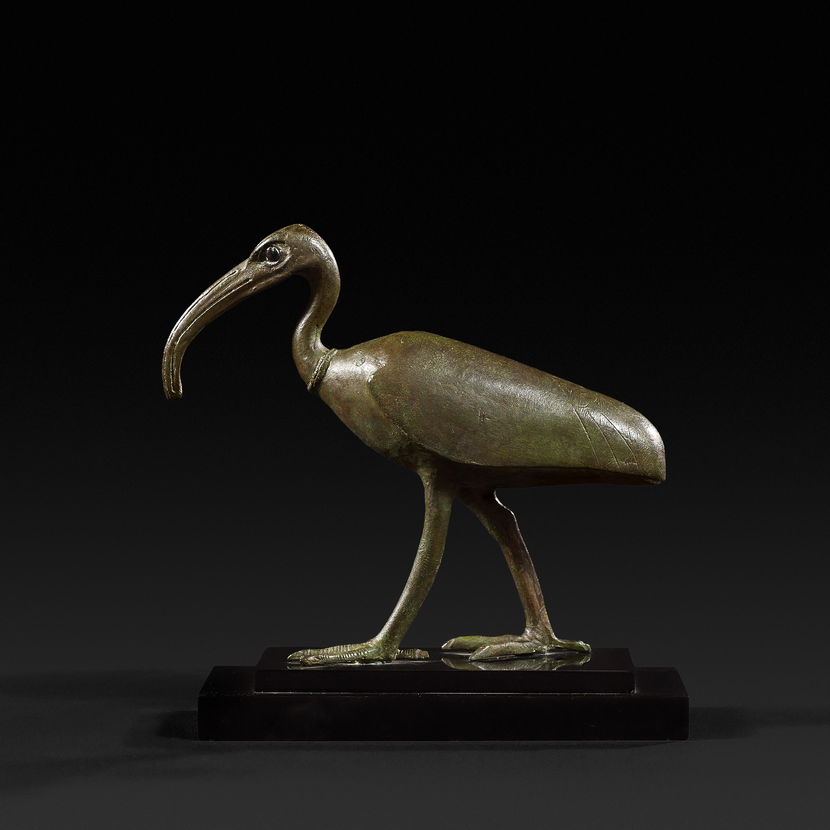
Striding Ibis, God Thot
The striding ibis is depicted with its head erect and a long, curved beak, while a braided necklace is shown in relief at the base of its slender neck. Detailed markings of the feet and tail feathers, black inlaid eyes.
Egypt
Late Dynastic Period , 664-332 BC
Bronze
Height 15 cm ( 5 7⁄8 in )
Former private collection C.B. Paris, France, acquired in 1970’s
G. Roeder: Ägyptische Bronzefiguren, Staatliche Museen zu Berlin, Berlin 1956
S. Schoske/D. Wildung: Gott und Götter im Alten Ägypten, Mainz 1992
P. Vernus et J. Yoyotte: Bestiare des Pharaons, Perrin, Paris 2005
 Share
Share  Print
Print  Call Us
  Enquire
The striding ibis is depicted with its head erect and a long, curved beak, while a braided necklace is shown in relief at the base of its slender neck. Detailed markings of the feet and tail feathers are finely engraved, and the eyes are inlaid with black.
Demonstrating their exceptional naturalistic skill, the Egyptians were able to capture in this bronze ibis the bird's long legs and graceful silhouette. Most effigies depict the left leg advanced, as if taking large, cautious steps along the marshy banks.
In Egyptian mythology, Thoth (Djehuty in ancient Egyptian) is the lunar god of Khemenu (Hermopolis Magna) in Middle Egypt. He embodies intelligence and speech, is the inventor of writing and language, and serves as the scribe of the gods, possessing unlimited knowledge.