Previous
Relief with offering scene
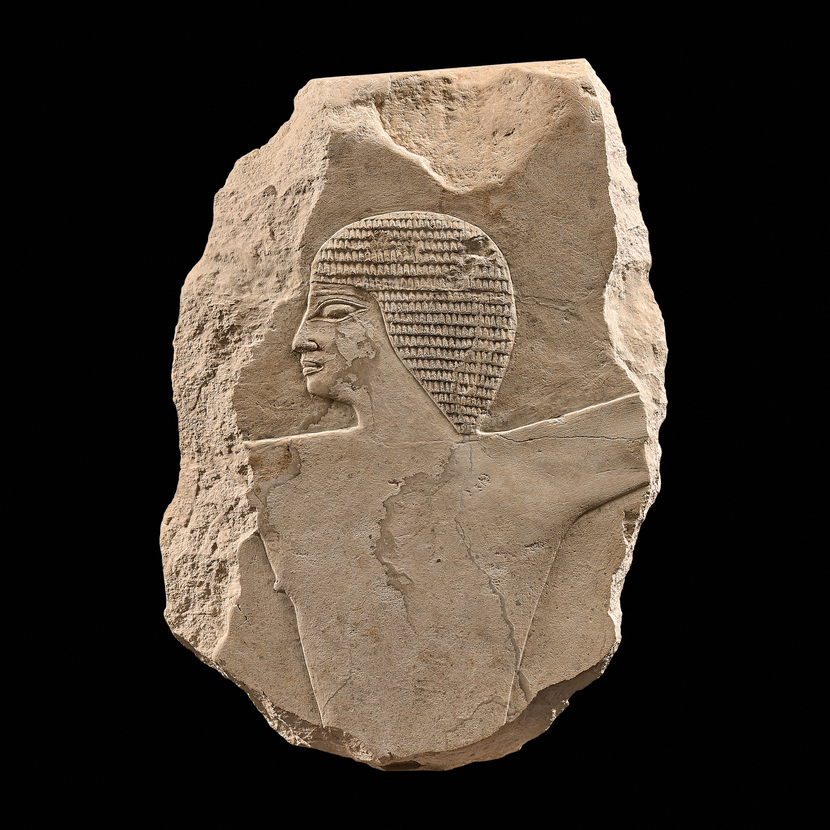
Relief from the wall of a tomb depicting a procession of three offering bearers walking from right to left, carrying various live birds.
The inscription between the first two figures mentions: "The chief of the Ka-priests, Ankhhaf “
Egypt
Old Kingdom , 2345-2181 BC
Limestone
Height 26 cm ( 10 1⁄4 in )
Length 53 cm ( 20 7⁄8 in )
Former private collection Paris, France prior to 1994
L. Klebs: Die Reliefs und Malereien des Alten Reiches, Heidelberger Akademie der Wissenschaften, C. Winter, Heidelberg 1915
R. Ho?lzl: Reliefs und Inschriftensteine des Alten Reichs, Philipp von Zabern Mains 1999
K. Lehmann: Der Serdab in den Privatgra?bern des Alten Reiches, Heidelberg 2000
 Share
Share  Print
Print  Call Us
  Enquire
Relief from the wall of a tomb depicting a procession of three offering bearers walking from right to left, carrying various live birds. The men are bare-chested, wearing only short kilts knotted at the waist and large ouserkh collars.
Above the scene, the hieroglyphic inscription reads: "… His companions and the Ka-priests for his eternity, for the captain of the crew of the boat, mery….". The inscription between the first two figures identifies Ankhhaf as "The chief of the Ka-priests".
From the Old Kingdom onwards, funeral needs led to the development of economic structures dedicated to providing goods for the deceased. Initially, this responsibility fell to the eldest son. However, over time, professional priests, Hmw-kA, or "Servants of the Ka", took over, overseeing rituals performed by the Wab-priests.
These priests managed daily cult practices and facilitated the transport of funerary items, such as furniture, cages, etc. For heavier or more prestigious cargoes, trained and physically fit men were preferred. As seen in this relief, the apr wiA, or "boat team" played a key role in such tasks. A notable example of their work appears in a scene from the causeway of Pharaoh Sahure’s pyramid, which depicts the transport of his pyramidion.